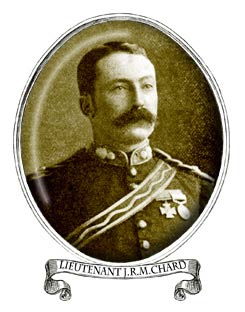
you are currently viewing: Lt. John Rouse Merriott Chard


Lt. John Rouse Merriott Chard (Royal Engineers).

Chard, officer left to command Rorke's Drift by Major Spalding. Died of cancer of the tongue 1st. November 1897 while living with his brother.

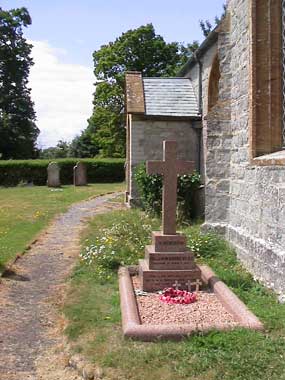
Directions to Memorial

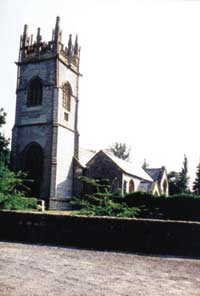
He is buried in the churchyard of St. John the Baptist, Hatch Beauchaup, near Taunton in Somerset. From the A5 south from Bristol, take the A358 south. Follow the sign off to the left for Hatch Beauchamp.

Entering the village turn left at the junction. 400 yards along turn left and head to the large house which has the church behind it. The grave of Chard is on the south side of the church, easily found.

There is also nearby round the corner to the right, a stained glass window in the church which is dedicated to him, best viewed from inside the church. Note the gravestone reads 'The hero of Rorke's Drift'.

Click here to see a map

Rough location can be found on Google Earth at:

50° 59' 6.88" N 2° 59' 23.96" W


Signature of JRM Chard, from the collection of Edward.T. Garcia

Why was he awarded the Victoria Cross?

Aged 31, he was in command of Rorke's Drift with Bromhead his second in command, showing great leadership throughout.

Read Lieutenant Chard's report to Queen Victoria and hear how "In wrecking the stores in my wagon, the Zulus had brought to light a forgotten bottle of beer, and Bromhead and I drank it with mutual congratulations on having come safely out of so much danger."

Further Information

John Chard was born near Plymouth in December 1847. His elder brother became a Colonel in the Royal Fusiliers. His younger brother was a clergyman. There were four sisters. He was commissioned into the Royal Engineers in July 1868. He served in Bermuda and Malta. He joined No. 5 Company RE in South Africa in 5 January 1879.

He did not arrive at Rorke's Drift until 19 January and was the senior officer present on 22/23 January 1879, having been left in command by Major Spalding. He was given a brevet Majority after Rorke's Drift. He received the VC from Sir Garnet Wolseley at St Paul's, Zululand on 16 July 1879.

Chard visited Queen Victoria at Balmoral twice in October 1879 and February 1880. He served in Singapore as a Lieutenant Colonel between 1892-1896.

He returned to take up a post in Perth in Scotland. Whilst there, he was again invited to see Queen Victoria, but soon began to suffer from cancer.

Chard visited Queen Victoria at Balmoral twice in October 1879 and February 1880. He served in Singapore as a Lieutenant Colonel between 1892-1896. He returned to take up a post in Perth in Scotland. Whilst there, he was again invited to see Queen Victoria, but soon began to suffer from cancer. He died at his brother's home at Hatch Beachamp, Somerset in November 1897, aged 49. He never married.


Chard, dressed in civilian clothing
Image supplied by John Young

Click here to see Stanley Baker at the grave

Interestingly, the Republic of South Africa created 'The John Chard decoration' and 'John Chard medal' as long service awards for their Citizen Force. (His VC is in a private collection).

Further Information supplied by the South Wales Borderers Museum, Brecon.

To read more about his life, please click here


Click on the grave inscription to zoom in, or click here

"Transcription of WO 32-7737 with a carefully redrawn version of Chard's original map". Information kindly supplied by Keith Smith.

Chard map

WO 32/7737

Reports on defence of Rorke’s Drift, with plan.

Minute Paper.

This report is a copy of Lieutenant Chard's official reports of the defence of Rorke's Drift, and a report also of the 6th February on the loss of a corporal and three men of the R.E. containing statements of so remarkable a character I think H.R.H. will be interested to read it.

J. M. Simmons,
24/3/79

I.G. of Fort’ns

H.R.H. has felt it necessary to send a copy of Lieutenant Chard's letter to Lord Chelmsford, for any observations he may think it necessary to make upon the subject.

G.H. Ellice
AG
27/3/79

Seen,
J. Hill,
31/3/79.

Rorke's Drift, 6th February 1879.

Sir,

I have the honour to report that about eight p.m. on the 21st January 1879, I received the order (herewith) for the NCO and three sappers under my command to proceed to join the head quarter column without delay. As my orders were to place the punts in working order, and these men leaving, left me without the necessary skilled labour for the purpose, I requested permission of Major Spalding Commanding at Rorke's drift to go to the camp at Isandhlwana to get definite instructions as to what I was to do on the following morning.

On the morning of the 22nd, I sent off the 4 men, in the mule wagon attached to 5th company R. E., with arms & field kit complete. They were driven to the foot of the hill below the Isandhlwana camp from where they marched up, the wagon returning here. I saw the men get out of the wagon and walk up the hill, on my return from the camp to which I had ridden on ahead of them. Finding none of the staff in camp I did not remain at more than a few minutes in the camp. Shortly before leaving my own men at about 10.30 a.m., and about ½ a mile from the camp, I met Colonel Durnford R. E. at the head of his mounted men. I told him of the movements of the enemy that I had seen from the camp and by his order rode back to Captain Russell, who was about a mile behind, and gave him the message to hurry up at once with his rocket battery, and detach a company of Sikali’s men to protect the baggage which was following, and I passed the word all along the line to look out to the left. On my return to Rorke's Drift, I reported to Major Spalding the movement to our left of the enemy that I had noticed, and the impossibility of protecting the punts with a guard of only 7 men in the event of an attack. It told me that he had already intended going to Helpmakaar to hurry on the company ordered to be brought here as a guard for the punts, that he should be back before dark, leaving me in command during his absence. I have had no definite news of the fate of the NCO and men referred to, viz:

Corp’l Gamble
Sapper Cuthbert
Sapper MacLaren
Sapper Wheatley

but there is every reason to believe that they are among the members of the killed in the disaster at Isandhlwana camp on the 22nd January 1879.

I wish to bring to your notice their exemplary conduct and cheerful obedience to orders, while under my charge, especially during the march up from Durban to this place, which owing to the heavy rain and bad roads was attended with many hardships and difficult.

I send herewith a copy of the report I furnished Colonel Glyn C.B., commanding 3rd Column, of the attack on Rorke's Drift on the 22nd Jan’y 1879.

I have the honour to be
Your obedient servant, John R.M. Chard
Lieut
.

To
The Officer Comm’g
5th Comp’y R.E.

Rorke’s Drift – Successful defence of.

Pietermaritzburg, Natal,
12th February 1879.

Sir,

I have the honour to enclose reports from Lieutenant Chard R.E. of the successful defence of Rorke's Drift on the night of 22nd January 1879.

There is little doubt but, that for the splendid defence made by Lieut Chard and the Officers and men under his command, that the whole of the Column would have been destroyed, and all the upper portion of Natal laid open to attack from the Zulus.

I have the honour to be,
Sir,
Your obedient servant,
F. Hassard, Colonel R.E.,
Commanding Royal Engineers,
S.A
.

The Inspector-General of Fortifications,
War Office,
London S.W.

Rorke’s Drift, 25th January 1879.

I have the honour to report that on the 22nd instant I was left in command at Rorke’s Drift by Major Spalding who went to Helpmakaar to hurry in the Company 24th Regiment ordered to protect the ponts.

About 3.15 p.m. on that day, I was at the ponts when two men came riding from Zululand at a gallop and shouted to be taken across the river.

I was informed by one of them, Lieutenant Adendorff, of Lonsdale’s regiment (who remained to aid in the defence), of the disaster at Isandhlwana Camp, and that the Zulus were advancing on Rorke’s Drift. The other, a Carabineer, rode off to take the news to Helpmakaar. Almost immediately I received a message from Lieutenant Bromhead, commanding the Company 24th Regiment at the Camp near the Commissariat Stores, asking me to come up at once.

I gave the order to inspan, strike tents, put all stores, &c., into the wagon, and at once rode up to the Commissariat Store and found that a note had been received from the 3rd Column to state that the enemy were advancing in force against our post, which we were to strengthen and hold at all costs.

Lieutenant Bromhead was most actively engaged in loopholing and barricading the store building and hospital, and connecting the defence of the two buildings by walls of mealie bags and two wagons that were on the ground. I held a hurried consultation with him and with Mr. Dalton of the Commissariat (who was actively superintending the work of defence, and whom I cannot sufficiently thank for his most valuable services), entirely approving of the arrangements made. I went round the position and then down to the ponts and brought up the guard of 1 serjeant and 6 men, wagon, &c. I desire here to mention the offer of the punt man “Daniells” and Serjeant Milne, 3rd Buffs, to moor the ponts in the middle of the stream and defend them from their decks with a few men. We arrived at the post about 3.30 p.m. Shortly after an officer of Durnford’s Horse [Lt Alfred Henderson] arrived and asked for orders. I requested him to send a detachment to observe the drifts and ponts, and throw out outposts in the direction of the enemy, and check his advance as much as possible, falling back upon the post when forced to retire and assisting in its defence. I requested Lieutenant Bromhead to post his men, and having seen his and every man at his post, the work once more went on.

About 4.20 p.m. the sound of firing was heard behind the hill to our south. The officer of Durnford’s returned, reporting the enemy close upon us, and that his men would not obey his orders, but were going off to Helpmakaar, and I saw them, apparently about 100 in number, going off in that direction. About the same time Captain Stephenson’s detachment of Natal Native Contingent left us, as did that officer himself.

I saw that our line. of defence was too extended for the small number of men now left us, and at once commenced a retrenchment of biscuit boxes.

We had not completed a wall two boxes high, when about 4.30 p.m. 500 or 600 of the enemy came in sight around the hill to our south, and advanced at a run against the south wall. They were met by a well sustained fire, but notwithstanding their heavy loss, continued the advance to within 50 yards of the wall, when they were met by such a heavy fire from the wall and cross fire from the store, that they were checked, but taking advantage of the cover afforded by the cook house, ovens, &c., kept up a heavy fire.

The greater number, however, without stopping, moved to the left around the hospital, and made a rush at our north west wall of mealie bags; but after a short, but desperate struggle, were driven back with heavy loss in the bush around the work. The main body of the enemy were close behind and had lined the ledge of rock and caves overlooking us about 400 yards to our south, from where they kept up a constant fire, and advancing somewhat more to their left than the first attack, occupied the garden, hollow road, and bush in great force.

Taking advantage of the bush which we had not time to cut down, the enemy were able to advance under cover close to our wall, and in this part soon held one side of the wall, while we held the other. A series of desperate assaults were made extending from the hospital along the wall as far as the bush reached, but each was most splendidly met and repulsed by our men with the bayonet. Corporal Schiess, Natal Native Contingent, greatly distinguishing himself by his conspicuous gallantry. The fire from the rocks behind us, though badly directed, took us completely in reverse, and was so heavy that we suffered very severely, and, about 6 p.m. were forced to retire behind the retrenchment of biscuit boxes.

All this time the enemy had been attempting to force the hospital, and shortly after set fire to its roof. The garrison of the hospital defended it room by room, bringing out all the sick who could be moved before they retired. Privates Williams, Hook, R. Jones, and W. Jones, 24th Regiment, being the last men to leave, holding the doorway with the bayonet, their own ammunition being expended. From the want of interior communication and the burning of the house it was impossible to save all. With most heartfelt sorrow I regret we could not save these poor fellows from their terrible fate. Seeing the hospital burning, and the desperate attempts of the enemy to fire the roof of the stores, we converted two mealie bag heaps into a sort of redoubt, which gave a second line of fire all round; Assistant Commissary Dunne working hard at this though much exposed, and rendering valuable assistance.

As darkness came on we were completely surrounded, and after several attempts had been gallantly repulsed, were eventually forced to retire to the middle and then inner wall of the kraal on our east. The position we then had we retained throughout. A desultory fire was kept up all night and several assaults were attempted and repulsed ; the vigour of the attack continuing until after midnight, our men firing with the greatest coolness did not waste a single shot. the light afforded by the burning hospital being of great help to us.

About 4 a.m., 23rd instant, the firing ceased, and at daybreak the enemy were out of sight over the hill to the south west. We patrolled the ground, collecting the, arms of the dead Zulus, and strengthened our defences as much as possible. We were removing the thatch from the roof of the stores, when about 7 a.m. a large body of the enemy appeared on the bills to the S.W..

I sent a friendly Kaffir, who had come in shortly before, with a note to the Officer Commanding at Helpmakaar asking for help. About 8 a.m. the third column appeared in sight, the enemy, who had been gradually advancing, falling back as they approached. I consider the enemy who attacked us to have numbered about 3,000 (three thousand). We killed about 350 (three hundred and fifty).

Of the steadiness and gallant behaviour of the whole garrison, I cannot speak too highly. I wish especially to bring to your notice the conduct of :–

Lieut Bromhead, 2/24th Regt, and the splendid behaviour of his Company B, 2/24th Regiment.
Surgeon Reynolds, AMD, in his constant attention to the wounded under fire where they fell.
Acting Comm’t Officer Dalton, to whose energy much of our defences were due, and who was severely wounded while gallantly assisting in the defence.
Assist. Comm’y Dunne.
Acting Storekeeper Byrne (killed).
Colour Serjeant Bourne, 2/24th.
Sergt Williams, 2/24th (wounded dangerously).
Sergt Windridge., 2/24th.
Corporal Schiess, 2/3rd Natal Native Contingent (wounded).
1395 Private Williams, 2/24th.
Private H. Hook, 2/24th.
593 Private Jones, 2/24th.
716, Private R. Jones, 24th.
Private McMahon, A.H.C.
Private Roy, 1/24th.

The following return shows the numbers present at Rorke’s Drift, January 22nd 1879:-

 
Officers
N.C     
Sick
Total
 
Staff
1
1
Royal Artillery
1
3
4
Royal Engineers
1
1
2
3rd Buffs         
1
1
1-24th Regiment
6
5
11
2-24th Regiment, B Company, 17 casuals sick  
1
81
17
99
90th Light Infantry
1
1
Commissariat and Transport Department
3
1
4
Army Medical Department
1
3
4
Chaplain
1
1
Natal Mounted Police
3
3
Natal Native Contingent
1
6
7
Ferryman
1
1
 
8
96
35
139

The following is a list of the killed:

Sergt Maxfield, 2/24th Regiment.
Private Nicolls, 1/24th Regiment.
Private Scanlan “ “
Private Harrigan, “
Hayden “ “
Jenkins Adams “ “ Mr. Byrne. Commissariat Department.
Cole “ “ Trooper Hunter, N.M. Police.
Fagan “ “ Trooper Anderson, N.N.C.
Chick “ “ 1 Private (Native) “
1398 Private Williams “ “
Total 15.

Twelve wounded* of whom two have since died, viz.:–

Serjeant Williams, 2/24thRegt;
Private Beckett, 1/24th Regt;
making a total killed of 17.
Herewith is appended a plan of the buildings, showing our lines of defence. The points of the compass referred to in this report are, as shown in sketch, approximately magnetic.

I have, &c.
John. R. M. Chard,
Lieut R.E.
Colonel Glyn, C.B.,
Commanding 3rd Column.

Minute Paper

Write C.R.E. he must act upon the orders he has received from the G.O.C. and that these with the R.A.R. Vol. V will be a sufficient guide for him for all occasions.

[Signature illegible]
26/6

Horse Guards,
War Office,
London SW.
27th March 1879.

My Lord,

The enclosed copy of a letter from Lieut. Chard, Royal Engineers, has been laid before the Field Marshal Commanding-in-Chief by the Inspector-General of Fortifications, and it is now forwarded to you for any comments Your Lordship may deem necessary, for the information of His Royal Highness.

This communication has been improperly transmitted by the Officer Commanding the Royal Engineers, under your command, directed to the Inspector General of Fortifications. I have therefore the honour to request that your Lordship will be pleased to point out to Colonel Hassard that no official communications respecting the Troops, or works, connected with operations in the Field (save such works the cost of which may be authorised in the Estimates), are to be forwarded to Head Quarters, except through the General Officer Commanding.

I have &c. &c.
(Sd) C.H. Ellice,
A.G.

Lt-Gen’l
Lord Chelmsford, K.C.B.

Hd Qrs, PMburg,
5.5.79
Colonel Hassard,
Would you please note this, and return me the papers forwarded herewith. (2)

(Sd)
H.H. Clifford,, M.G.,
I.G.L.C. of B.

I.G.F.

Am I to understand that in future, no report, plans, etc, even duplicates, of operations in the Field are to be sent to you. I have not sent any except copies, but I do not consider the letter of Lieutenant Chard in the nature of a report as by [illegible] it will be seen it states that the report had been sent through proper channel and by letters addressed to his captain and I merely sent it in thinking is might be interesting to you.

F.C. Hassard,
Col., C.R.E.
20 May 1879

Back